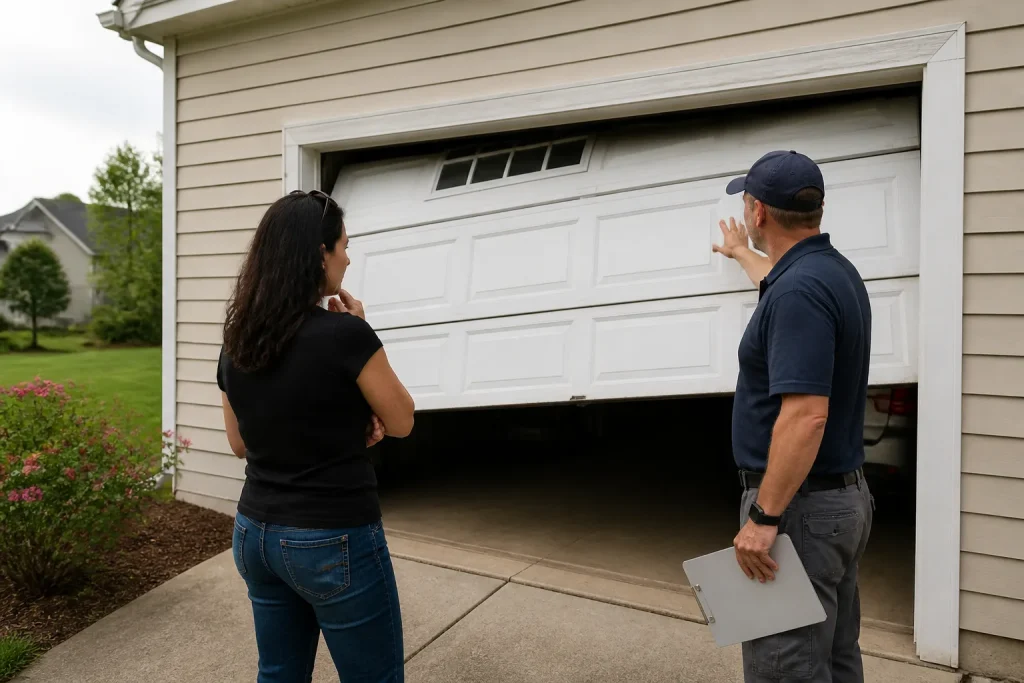
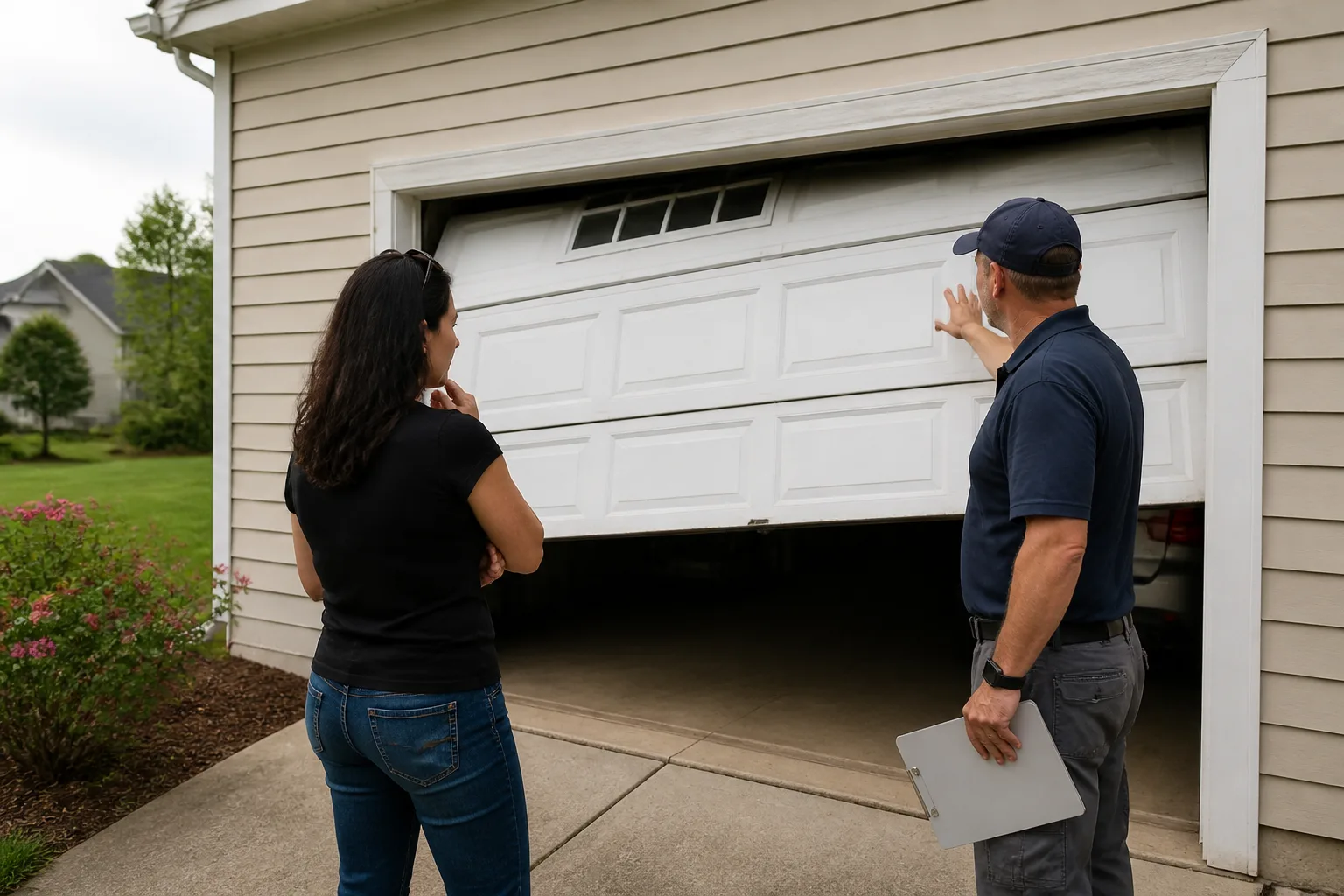
Garage Door Repair: Repair or Replace? How Hamilton Homeowners Decide
Most homeowners assume the decision comes down to age. It doesn’t. Two Hamilton garage doors built the same year can land on opposite sides of the repair-or-replace line, and the deciding factors are structural condition, mechanical wear, and what the door’s remaining service life is actually worth to you. This guide gives you the same framework our technicians use on a diagnostic call, so you can reach your own conclusion rather than take a salesperson’s word for it. If you’d rather not sort it out yourself, call (855) 502-5595 and we’ll walk you through it.
Key Takeaways
- The repair-or-replace call is about whether all three systems (structural, mechanical, operational) can be brought back to safe operation at a sensible cost, not how old the door is.
- If two of the three systems are compromised, replacement usually wins on math.
- A 15-year-old door with one cracked panel but healthy springs and hardware is almost always a repair.
- A younger door with two replaced springs, a bent track, and worn rollers is often a replacement candidate.
- Ask your technician one direct question: “If this were your door, which choice would you make, and why?”
Why age is the wrong metric for a Hamilton garage door
A 15-year-old door with one cracked panel and healthy springs is usually a repair. A 10-year-old door with two replaced springs, a bent track, and worn rollers is often a replacement, even though it’s younger. That’s the counterintuitive truth most homeowners in Hamilton don’t hear from a sales pitch.
Here’s why it works that way. A garage door has three separate systems running on a shared frame, and they wear at different rates depending on how often the door runs, whether the springs were matched correctly, and whether the tracks were ever knocked out of alignment (a common result of a car bumper tapping the rail). A door that gets opened four times a day wears very differently from one that sits closed for weeks at a time. That’s why a Hamilton household with two working vehicles logging multiple openings daily can reach the wear threshold faster than a similar door with a single-driver household.
Age does tell you something: springs have a finite cycle count, and hardware wears over time. But it doesn’t tell you whether a particular door is worth saving. Only the actual condition of each system does. We’ve seen 18-year-old doors run like new after a spring and roller refresh, and we’ve seen 9-year-old doors with structural fatigue that no repair budget fixes cleanly.
The right way to start is to stop thinking in years and start thinking in systems. That’s the next section.
The three-system check: structural, mechanical, and operational
Every garage door decision should start with an honest look at three distinct systems. If two of the three are compromised, the replacement math usually wins. If only one is compromised, repair is almost always the smarter move.
1. Structural system (panels, sections, frame)
- Panels: visible cracks, delamination, dents that bind the hinges, rot at the bottom edge.
- Sections: sagging or bowed middle sections, gaps that no longer close evenly.
- Frame and header: twisting or separating from the jamb is a red flag on any door.
One dinged section on an otherwise solid door is a repair. Multiple failing sections on a door built of a discontinued profile is usually a replacement, because matching a new section to an old panel never looks quite right and can throw the balance off.
2. Mechanical system (springs, cables, rollers, tracks)
- Springs: fracture on either torsion or extension springs; a single snapped spring leaves the door unsafe to operate.
- Cables: fraying, slack, or off the drum.
- Rollers and hinges: flat-spotted rollers, worn hinge plates, loose brackets.
- Tracks: bends, separation, or mounting pulling out of the jamb.
Multiple springs replaced already, plus a bent track and worn rollers, is the classic “replace sooner than the door’s age suggests” combination. One spring replacement with otherwise healthy hardware? Repair, no question.
3. Operational system (opener, sensors, controls)
- Opener: motor failure, stripped gears, control board faults on LiftMaster, Chamberlain, Genie, or Raynor units.
- Safety sensors: misaligned or non-responsive, forcing the door to reverse.
- Limit switches, travel adjustments, wall controls, remotes.
A dead opener doesn’t mean a dead door. On a structurally sound door with good mechanicals, an opener repair is the cheapest path forward and can add years of service. Our garage door opener repair team works on the drive systems most Hamilton homes actually have.
Applying the framework
Score each system as healthy, compromised, or failed. Two compromised or failed = replacement math wins. One compromised with two healthy = repair. One failed with two healthy = repair, with an eye on what fails next.
How to calculate the real repair-versus-replace threshold
The financial decision isn’t “cost of this repair” versus “cost of a new door.” It’s “cost of all the repairs this door will need across its remaining service life” versus “cost of a new door installed, minus the warranty value.” That’s a different number, and it usually tilts the answer.
Here’s the formula. None of the figures below are quotes; they’re the framework we walk through on a diagnostic call.
- Estimate remaining service life. A well-maintained door typically runs 15 to 20 years before structural fatigue catches up. If your door is halfway through its service life, you have years to amortize the next repair.
- List the repairs likely needed in that window. A spring set, a roller and hinge refresh, possibly a track realignment. Add the opener if it’s older than the door.
- Multiply by annual maintenance expectation. Most homeowners in Hamilton spend something on their door every few years. Ballpark this without obsessing.
- Compare against a new door installed with warranty. A new door resets both clocks (mechanical and structural) and usually comes with a warranty on sections and hardware.
The threshold we use: if the projected repair spend across remaining life edges past roughly 40 to 50 percent of the installed cost of a new door, replacement is usually the better long-term call. Below that, repair wins on value, and you preserve the look and character of your existing door.
If your door fits the repair-first case, our garage door repair team can usually get it back to safe operation with one visit. We quote the work before we touch a tool, so you know the number before any repair starts.
What partial replacement actually means (and when it’s a real middle path)
Partial replacement gets sold as the sensible middle. Sometimes it is. Often it’s a temporary fix that hides a failing system and comes back to bite you a year later. Knowing the difference saves you money.
The three legitimate partial-replacement options
- Section swap. Replace one damaged section while keeping the rest. Works when the door profile is still available (Clopay and Amarr keep a deep parts catalog, which is why we work on those brands) and the surrounding sections are structurally sound.
- Panel matching on a full section sweep. Replace the bottom two sections if the bottom has taken the bulk of the wear. Legitimate when the top sections still have good life and the door profile is current.
- Hardware overhaul. New springs, cables, rollers, and hinges on a structurally healthy door. This is often the highest-value partial replacement available and can put years back on the clock.
When partial replacement is a temporary fix
If you’re swapping a section on a door that already shows fatigue in adjacent panels, or the tracks are out of alignment and the springs have cycled through two lives, the section swap buys you time but doesn’t solve the underlying problem. In that scenario, we tell homeowners honestly: partial replacement here is really a stopgap toward a full replacement next year, and it’s better to plan for that than be surprised.
Partial replacement is also where brand knowledge matters. Some door profiles are discontinued, which makes a section swap impossible. Others are still in production, which makes it a clean job. When we quote partial replacement on a Clopay, Amarr, Wayne Dalton, or Raynor door, we know what’s still in the parts channel.
Curb appeal and resale: when aesthetics tilt the math
Hamilton-area homeowners planning a sale often bring a different question: even if the door is repairable, will replacement pay for itself at resale? Sometimes yes. Sometimes the honest answer is to repair now and let the next owner replace.
When aesthetics tilt toward replacement
- The door is the visual weak point of the home’s front elevation and shows it in listing photos.
- The style is dated in a way that no repair will freshen (flat panel in a neighborhood of carriage-house styles, or the reverse).
- The repair cost is already climbing toward 40 percent of the new-door price, meaning the marginal cost of replacement is small.
- You’re selling within a year and want the front elevation carrying its weight.
When repair wins on curb appeal, too
- The door is characterful and fits the home. Replacing it removes value rather than adding it.
- The damage is cosmetic but small (a dent on one lower section). A targeted repair restores the look at a fraction of replacement cost.
- You’re not selling soon, and the door’s style has years of life left.
If you’re two years or more from selling, the resale math doesn’t tip a repairable door toward replacement on its own. Structural and mechanical soundness should drive the decision; the curb-appeal bump on a new door is real but should be a tiebreaker, not the whole case. If you’re going to replace, our garage door installation team can walk through styles that fit your home’s existing architecture rather than selling you the display door.
How to get a genuinely unbiased assessment
Sales-driven assessments tilt toward replacement. Diagnostic assessments tilt toward repair. Ask the right questions and you’ll know which one you’re getting.
Questions that reveal whether the replacement recommendation is real
- “What specifically is wrong with each of the three systems?” If they can’t name structural, mechanical, and operational concerns separately, the diagnosis isn’t complete.
- “Which single repair would buy me the most time, and how long?” A technician who can answer this can actually weigh the repair case.
- “If this were your door, what would you do?” This is the honest-question pivot. A salesperson leans on features and a new-door pitch. A technician names a specific repair and a specific window.
- “Can you show me the failure?” A snapped spring, a bent track, and a frayed cable are visible. If they can’t point at the failure, ask why.
- “What’s the warranty difference between repairing and replacing?” The real comparison isn’t price, it’s price against warranty and service life.
When to call a pro
Springs, cables, and torsion systems are genuinely dangerous to service without training, and we don’t recommend DIY on those. If your door is stuck open or stuck closed and you need it working today, our Hamilton Garage Door Repair Pros team takes emergency calls because a broken door compromises both access and security. For everything else, get the assessment, then decide.
Related services in Hamilton: garage door repair, garage door opener repair, and garage door installation. We work on the brands most homes in Hamilton already have, including LiftMaster and Chamberlain openers.
The Bottom Line
Age is the wrong metric. Condition across the three systems is the right one. If structural, mechanical, and operational health are all workable (even if one repair is needed), repair wins on value. If two of the three are compromised, replacement math usually wins. Partial replacement lives in the middle, and it’s a legitimate path when the door profile is available and the surrounding system is sound.
The single best question to ask a technician is “if this were your door, what would you do?” If the answer is a specific repair with a specific window, trust it. If the answer is a menu of new-door options, ask again.
If you’re in Hamilton and need help deciding, Hamilton Garage Door Repair Pros offers free estimates and works on LiftMaster, Chamberlain, Genie, Clopay, Amarr, Wayne Dalton, Craftsman, and Raynor equipment. Call (855) 502-5595.
Frequently Asked Questions
Repair is usually cheaper in the short term. A spring, cable, or opener repair typically costs far less than a full replacement, and it’s the right call if the structural, mechanical, and operational systems are mostly healthy. Replacement only becomes cheaper over the medium term when two of those three systems are already compromised, because the accumulated repair spend runs past roughly half the installed cost of a new door. Call (855) 502-5595 for a free estimate on either path.
Track damage is repairable when the bend is small, the mounting is intact, and the door still travels evenly. It’s usually a replace-the-track-and-reassess situation when the track has separated from the jamb, when multiple bends exist, or when the door binds on the track regardless of adjustment. Have a technician look at both the track and the springs at the same time; a bent track often indicates the door has been running off-balance, which stresses the springs. Call (855) 502-5595 to book a diagnostic.
Yes, if the section profile is still in production and the surrounding panels are structurally sound. Clopay, Amarr, Wayne Dalton, and Raynor all keep deep parts catalogs, which makes panel matching feasible on those brands. It becomes a temporary fix rather than a real solution when adjacent panels show fatigue, when the tracks are out of alignment, or when the springs have already cycled through two lives. Call (855) 502-5595 and we’ll tell you honestly which of the two it is.
Ask “if this were your door, what would you do, and why?” A sales-driven technician will pivot to new-door features and monthly payments. A diagnostic technician will name the specific failed component and a repair window. Also ask them to show you the failure (spring, cable, roller, panel) and to walk you through structural, mechanical, and operational condition separately. Those three questions separate diagnosis from pitch. Call (855) 502-5595 for a free estimate from a team that answers them.
Written by the team at Hamilton Garage Door Repair Pros.
Need Garage Door Help?
Call Hamilton Garage Door Repair Pros - the local pro we connect you with is licensed and insured, here with fast after-hours help in Hamilton.
(855) 502-5595